Slow Fashion & Wardrobe Longevity

Why Your Merino Wool Knitwear Keeps Shrinking: How Washing Temperature and Agitation in the First Ten Cycles Determine Its Lifespan

Merino wool shrinks on a gentle cycle because the machine’s spin speed and water temperature interact with the fibre’s microscopic scales, regardless of the cycle’s name. Using cold water and the correct detergent will not prevent this if the mechanical agitation exceeds the yarn’s structural limits.

This dimensional change is a predictable outcome of temperature, agitation, and fabric weight interacting in ways most care labels fail to explain. Understanding the mechanics behind this shrinkage dictates how you should wash merino and determines whether a garment survives its first ten cycles.

The Longevity Finding

  • Most merino shrinkage occurs during the first ten washes, though this damage usually falls into two distinct mechanical categories.
  • A garment’s survival depends on the interaction between water temperature, spin speed, and fabric weight rather than its initial retail price.
  • Evaluating your knitwear’s GSM alongside your machine’s specific settings allows you to predict dimensional changes and adjust your washing routine accordingly.

This analysis examines a mid-weight merino crewneck sweater made from 100% wool in the £80 to £150 price range, typically worn as a daily layer through autumn and winter. It addresses why this specific type of garment often shrinks during its first few washes despite being constructed for multi-year use.

Why the “gentle cycle” isn’t a guarantee

A washing machine’s wool or delicate cycle is not a universal standard, as different manufacturers interpret the term differently. Some models reduce drum agitation but still spin at 1,000 RPM, while others hold the water temperature at 40°C instead of 30°C.

The cycle name indicates the machine’s intention rather than the actual mechanical force your knitwear experiences. The Woolmark guidance confirms that certified wool cycles are tested to prevent felting shrinkage, though these parameters still vary and only apply to garments explicitly labelled as machine-washable.

Check your machine’s manual for the actual spin RPM of the wool cycle before your next wash. Some models marked as gentle still reach 800 RPM, which remains well above the safe threshold for protein fibres.

washing machine control panel with wool and delicate cycle settings
Photo by RDNE Stock project on Pexels

Two types of shrinkage: one you can reverse, one you cannot

Relaxation shrinkage occurs when the fabric settles into its natural dimensions after knitting, typically happening once during the first wash and remaining reversible through gentle stretching while damp. Felting shrinkage is permanent because heat and agitation cause the microscopic scales on the wool to interlock, tangling the fibres into a denser mass that cannot be unstretched.

If the garment feels noticeably stiffer and denser in addition to being smaller, you are dealing with irreversible felting rather than simple relaxation.

Owners of 150 to 200 GSM merino jumpers often notice the sleeves shortening after just five washes because the lower fibre density transfers more mechanical force per fibre. This concentrated agitation triggers scale interlocking at temperatures as low as 30°C.

A heavier 250 GSM sweater withstands more cycles because the extra fibre mass absorbs and disperses that mechanical energy before it reaches felting intensity.

merino sweater shown before washing and after felting shrinkage with visible size difference
Photo by Ksenia Chernaya on Pexels

Where most guides get this wrong

Most care guides treat all shrinkage as a single problem and offer a uniform solution of cold water, a gentle cycle, and flat drying. This approach misses the critical distinction between relaxation and felting while failing to explain why a garment can still felt at 30°C if the spin speed is too high.

The core mistake is focusing entirely on temperature while ignoring mechanical agitation, which often acts as the more significant factor in permanent felting.

What spin speed actually does to wool fibres

A spin speed above 600 RPM applies centrifugal force that pulls water through the fabric while simultaneously pulling the fibres themselves. This mechanical action accelerates the scale interlocking that causes felting, and at 1,000 RPM the force is strong enough to felt wool even at 30°C.

The Icebreaker care guide recommends a maximum spin speed of 500 RPM for its merino products. Other industry sources generally converge on 400 to 600 RPM as the safe operational range for knitwear.

If your machine’s display does not show the exact RPM, the wool cycle typically defaults to 600 or 800 RPM, which remains high enough to accelerate felting over multiple washes. This centrifugal force physically agitates the fibres against each other with enough pressure to overcome the natural resistance of the wool’s scale structure.

illustration of wool fibres being pulled and distorted during high-speed spin cycle
Photo by Engin Akyurt on Pexels

Temperature: the trigger that opens the scales

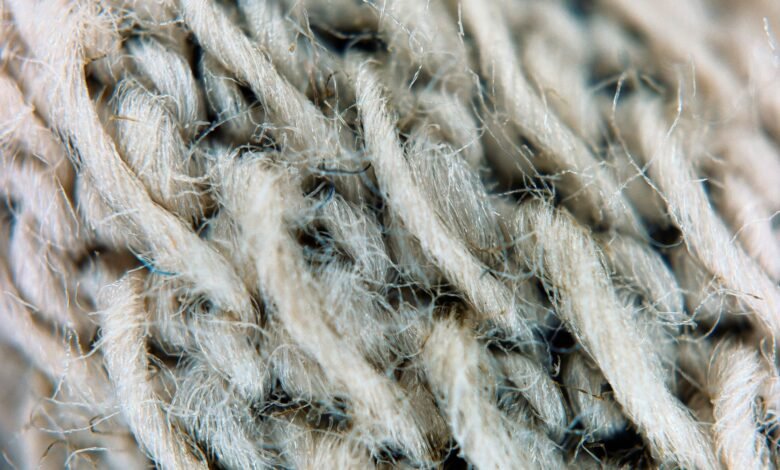
The microscopic scales on wool fibres open and become more pliable once the water temperature rises above 30°C. At 40°C these scales are significantly more exposed, making interlocking far more likely when combined with any mechanical agitation.

The WRAP/COS extended wash test found that merino jumpers washed at 30°C showed only marginal dimensional stability improvements over a cold wash. Both temperatures still produced shrinkage, confirming that heat is never the sole variable in this process.

This threshold is not a sharp cliff where fibres suddenly seize at 31°C. The probability of felting simply climbs steeply once the water passes that mark, especially when the spin cycle follows with even moderate mechanical force.

microscopic view of wool fibre scales in closed vs. opened state
Photo by Sohan Rahat on Pexels

GSM and knit structure: why weight matters

GSM, or grams per square metre, measures the physical weight of the fabric. Lighter merino knitwear in the 150 to 200 GSM range has less fibre mass to absorb mechanical force, making it more susceptible to felting under agitation.

Heavier knitwear around 210 to 280 GSM possesses greater structural density to resist fibre migration, though this protection only works up to a certain point.

Examining a 150 GSM base layer after a few wash cycles reveals a fabric that feels thinner and more compressed because the individual yarns have tightened against each other as scales locked. A 250 GSM sweater washed under identical conditions often shows less dimensional change because the extra fibre bulk dissipates the forces that would otherwise pull fibres into permanent tangles.

This relationship is not entirely linear, as even heavyweight knits will eventually felt once agitation exceeds the fabric’s ability to absorb it.

lightweight and heavyweight merino wool garments shown side by side for GSM comparison
Photo by Gaspar Zaldo on Pexels

Care label reality: what the symbols actually mean

Care labels on merino knitwear vary widely across different price tiers. A £40 sweater may carry a generic machine wash cold symbol with no temperature or spin specification, while a £150 piece often includes the Woolmark logo or explicit RPM guidance.

The GINETEX care labelling standard defines the symbols, but the brand’s choice of what to print creates an information gap. An OEKO-TEX® Standard 100 certification confirms the dye and finish are chemically safe, yet it sets no mechanical care requirements and does not address shrinkage thresholds.

The economics of ownership shift when the label omits critical details like the maximum safe spin speed or the exact temperature ceiling. A symbol indicating a gentle machine wash without RPM data tells you nothing about whether your specific machine will destroy the garment over ten cycles.

merino wool garment care labels showing different washing symbols and instructions
Photo by Ulrick Trappschuh on Pexels

Your merino care decision tree

This matrix maps your specific washing temperature, spin speed, knitwear GSM, and drying method to a predicted dimensional outcome. The shrinkage percentages provided are estimates based on typical knit construction behaviour observed over ten wash cycles.

Wash Setting GSM Range Predicted Shrinkage (10 cycles) Longevity Verdict
≤30°C, spin ≤600 RPM, flat dry 210–280 ≤3–5% Minimal risk; garment likely maintains wearable size
≤30°C, spin ≤600 RPM, flat dry 150–200 5–8% Moderate shortening; still wearable but watch sleeve and body length
≤30°C, spin >600 RPM, any GSM 150–280 8–15% Accelerated felting likely; garment may become unwearably small
>30°C, any spin, any GSM 150–280 10–30% High risk of irreversible felting; size loss and density increase make repair impractical

Flat drying in the shade is the only safe drying method, as tumble drying or hanging applies additional fibre stress that can worsen shrinkage even after a careful wash. The lower the GSM and the higher the spin speed, the faster felting progresses.

A 150 GSM sweater washed at 1,000 RPM may felt severely within three to five cycles under these conditions.

decision tree flowchart for merino wool care showing temperature, spin speed, GSM, and drying method branches
Photo by Tima Miroshnichenko on Pexels

The Longevity Verdict

The safe zone for machine-washing merino is narrow, requiring a temperature at or below 30°C, a spin speed no higher than 600 RPM, a fabric weight above 200 GSM, and flat drying. If your machine’s wool cycle exceeds 600 RPM, the risk of irreversible felting outweighs the convenience of using the appliance.

A £120 sweater that could have lasted for years becomes a felted crop top after ten washes.

Your most important action is to find your machine’s actual spin RPM on the wool cycle rather than trusting the gentle label. Hand washing or switching to a lower-spin machine remains the only reliable way to stop the cycle of replacing shrunken knitwear season after season.

Frequently Asked Questions

Can I reverse felting shrinkage once it has happened?

Felting permanently locks wool scales together into a denser mass, meaning the fabric cannot be stretched back to its original dimensions. Relaxation shrinkage, however, can often be reversed by gently stretching the damp garment.

Is a higher GSM always better for shrinkage resistance?

Heavier fabrics typically absorb mechanical force more effectively, making them more resistant to dimensional change. If the spin speed exceeds the fabric’s structural threshold, however, even 280 GSM knitwear will eventually felt over repeated cycles.

Does “superwash” merino wool shrink less than untreated merino?

Superwash treatment chemically removes or masks the microscopic scales on the wool, significantly reducing the risk of felting. This allows the garment to withstand higher agitation, though the chemical process may slightly reduce the fibre’s natural insulating properties.

How many washes can I expect before a merino sweater starts showing visible shrinkage?

A 210+ GSM sweater washed with a low spin speed and cool water may show only minor dimensional changes after ten cycles. Under high spin speeds or warmer water, visible shrinkage can appear within three to five washes.

Armughan Akbar

Armughan Akbar is a fashion and wardrobe content writer with over 6 years of experience covering fabrics, garment construction, clothing quality, fit, and apparel care. His content combines textile research, industry standards, and practical consumer guidance to help readers make informed wardrobe and clothing-buying decisions.
Back to top button